Old games, new friends: made multiplayer by the port skill
Four open-source web games and one of Homie's own, each made into a live public room by Homie's port skill. Press Play and you are in.
Every game on this site started life as a web game for one person: Gabriele Cirulli's 2048, Doug McInnes's HTML5 Asteroids, Jake Gordon's tiny platformer and the first-person octree demo from three.js. The fifth, Bone Burglar, is one of Homie's own living-room games. None of them was made for more than one player.
Homie's port skill changed that. It is part of the Homie plugin for Claude Code and Codex: the AI reads a game (its loop, its input, its state, its camera), says up front how hard the port will be, picks how a room should share the game, and adds the rest:
- Public rooms. Press Play and you are in a room at once. Nobody else there yet? Bots hold the empty seats, and the next person who presses Play takes a bot's place, mid-round.
- Every browser draws the game itself. Your own movement answers at once. One browser keeps the rules, and if it leaves, another carries on the same round.
- Phones and computers. On a phone, a stick appears where your thumb lands and a button or two waits at the edge, so the middle of the screen stays clear. On a computer, the keys the original used.
- The big screen. Open a game's
/tvaddress on any TV or laptop browser, scan the code it shows, and the phones on the couch are the controllers.
What changed in each
- 2048 Race: everyone slides the same deal of tiles for two minutes, and a full board deals you a fresh one.
- Asteroids Arena: up to six ships race each other on the same rocks. Shots never hit another ship.
- Tiny Platformer Party: gold and stomps on one tiny level, with a camera that follows you.
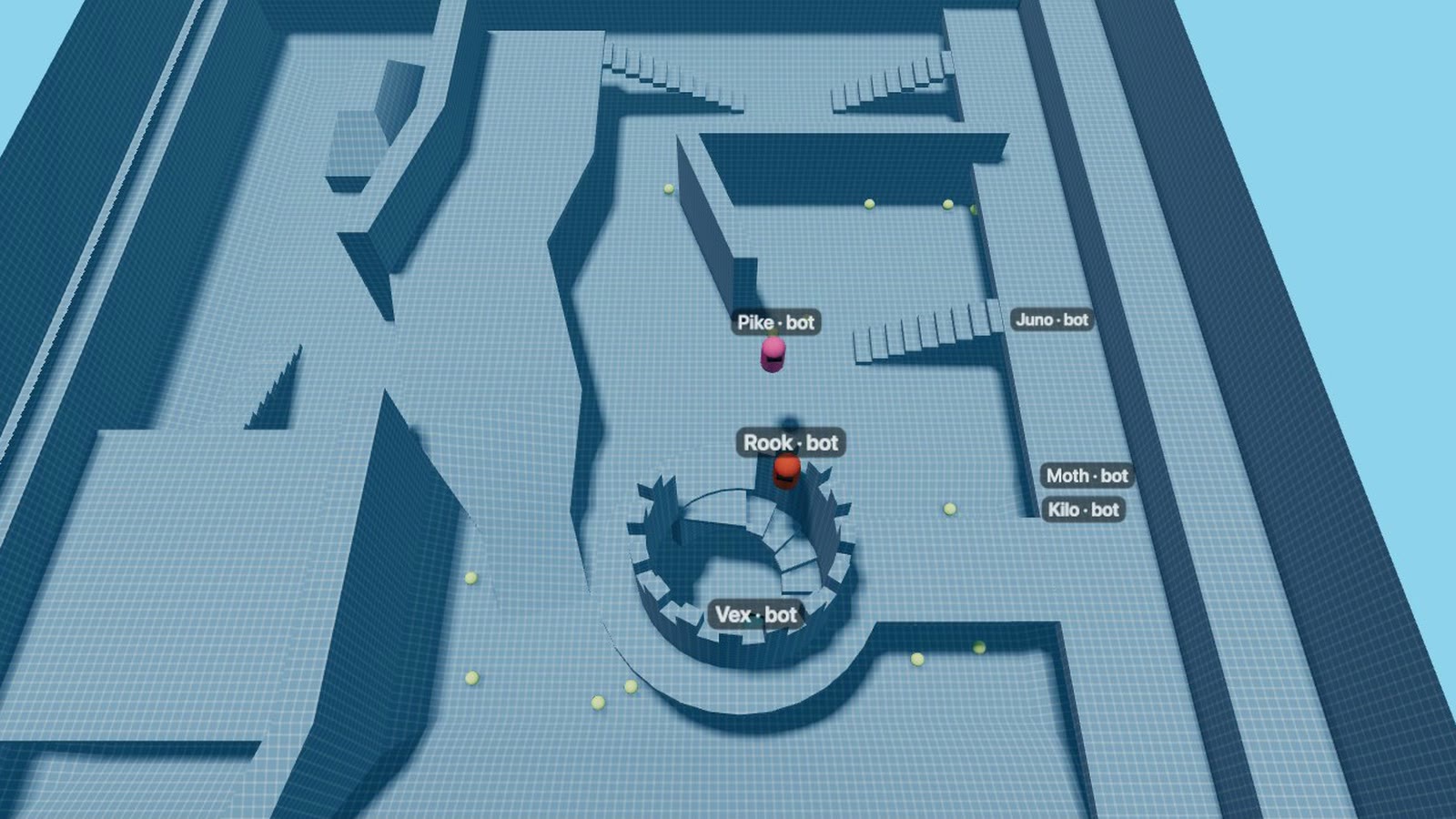
- Octree Arena: a first-person ball fight, where every hit is a point and a shove.
- Bone Burglar: six dogs in one garden maze, and the zoomies for everyone.
The skill graded each port before it began: 2048 easy; Asteroids, the platformer and Bone Burglar medium; Octree Arena hard, because its fast ball physics had to be shared between each player's own browser and the host. Each game's PORT.md says what changed and why.
Credit where it is due
The four originals are open source under the MIT licence, and every game's page credits its original, its author and every part inside it (the sounds, the typefaces, the libraries), with the licence texts in full on its credits page.
About the footage
The moving pictures on these pages were recorded from each game's big screen, in a room of its own, with nobody pressing anything: the players you see in them are the games' own bots. When you press Play, the next ones are people.
Make your own game multiplayer
Have a single-player web game going to waste? In Claude Code, add the Homie plugin (/plugin marketplace add homie-rocks/homie, then /plugin install homie@homie) and say "make this multiplayer on my studio". It tells you how hard it will be before it starts, and it runs the same checks these five passed: two browsers in one room, finishing a round.
Octree Arena
A first-person ball fight across a stone maze. Most hits in two minutes wins.